
In heavy industrial gearboxes, it is tempting to assume that a replacement gear set that fails within a very short time must have been made from the wrong material or manufactured poorly. That explanation is possible — but it is not the only one, and often not the first one that should be assumed.
Recently, we reviewed a case involving an industrial parallel-shaft gearbox in which the original unit had reportedly operated for many years. After routine maintenance, the pinion and mating gear were replaced by a third-party local supplier. Within about two days of operation, the replacement set suffered severe surface damage.
For confidentiality reasons, this article does not identify the site, customer, or manufacturer. The value of the case lies not in naming brands, but in understanding the failure mechanism.
 What the Damage Pattern Suggests
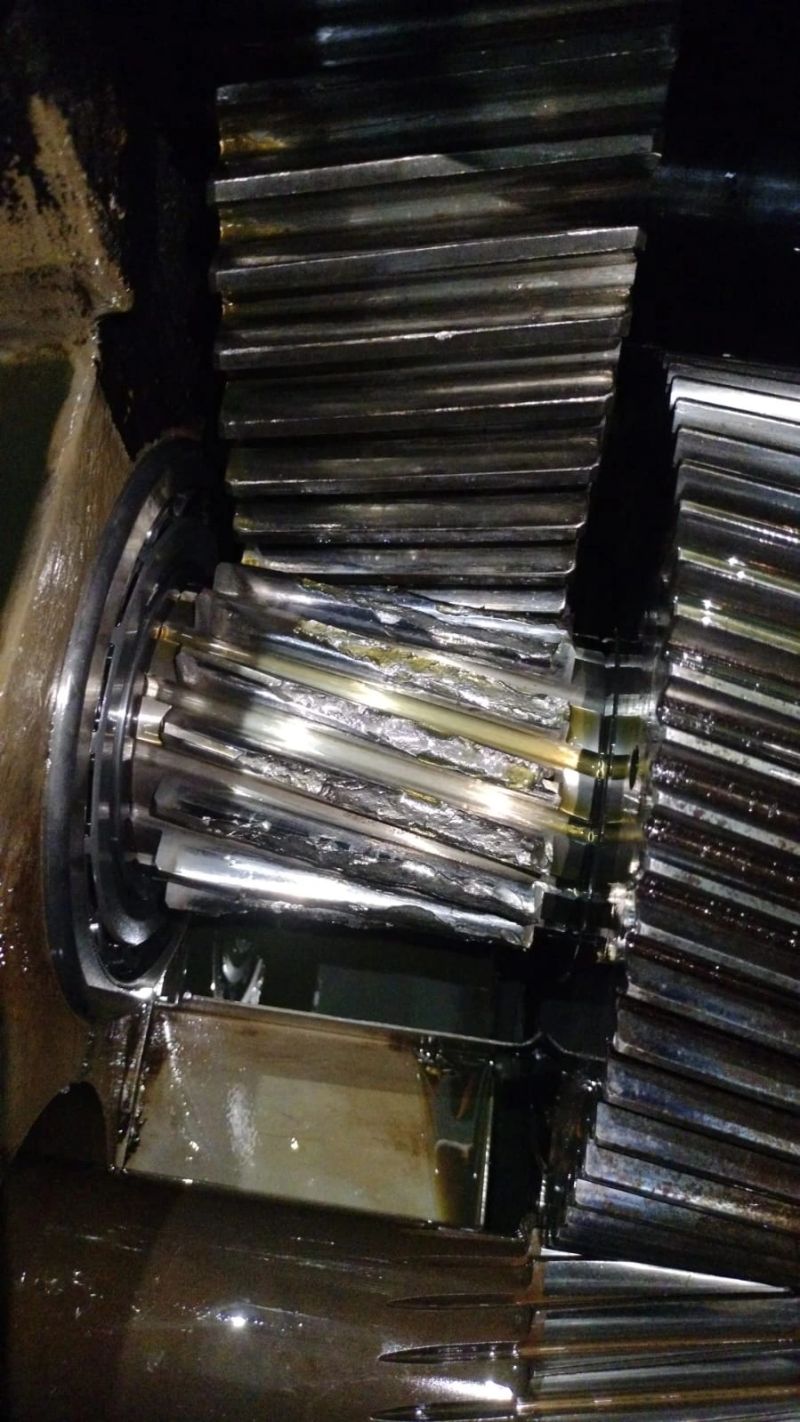
Based on the available image, the failed pinion shows:
-
severe surface distress across multiple teeth
-
large areas of smeared and torn metal
-
progressive surface removal rather than a clean tooth break
-
damage concentrated on the loaded flanks
This kind of appearance does not automatically prove a raw material problem. In many cases, it points more strongly to a combination of:
-
lubrication film breakdown
-
incorrect contact pattern
-
local overload or edge loading
-
mismatch between the replacement gear geometry and the existing gearbox system
In simple terms, the gear may have been “dimensionally installable” but still not “system-compatible” under real operating conditions.
Why “Bad Material” Is Not Only One Possible Hypothesis
Material or heat-treatment defects can certainly destroy a gear set. Examples include:
-
insufficient case depth
-
inadequate surface hardness
-
improper core hardness
-
grinding burn or metallurgical damage
-
inclusions or poor steel cleanliness
However, when a replacement set fails almost immediately, engineers should resist jumping straight to that conclusion. A rapid failure can also happen when the replacement gears are manufactured from acceptable material but are introduced into a system where one or more of the following conditions are not properly controlled.
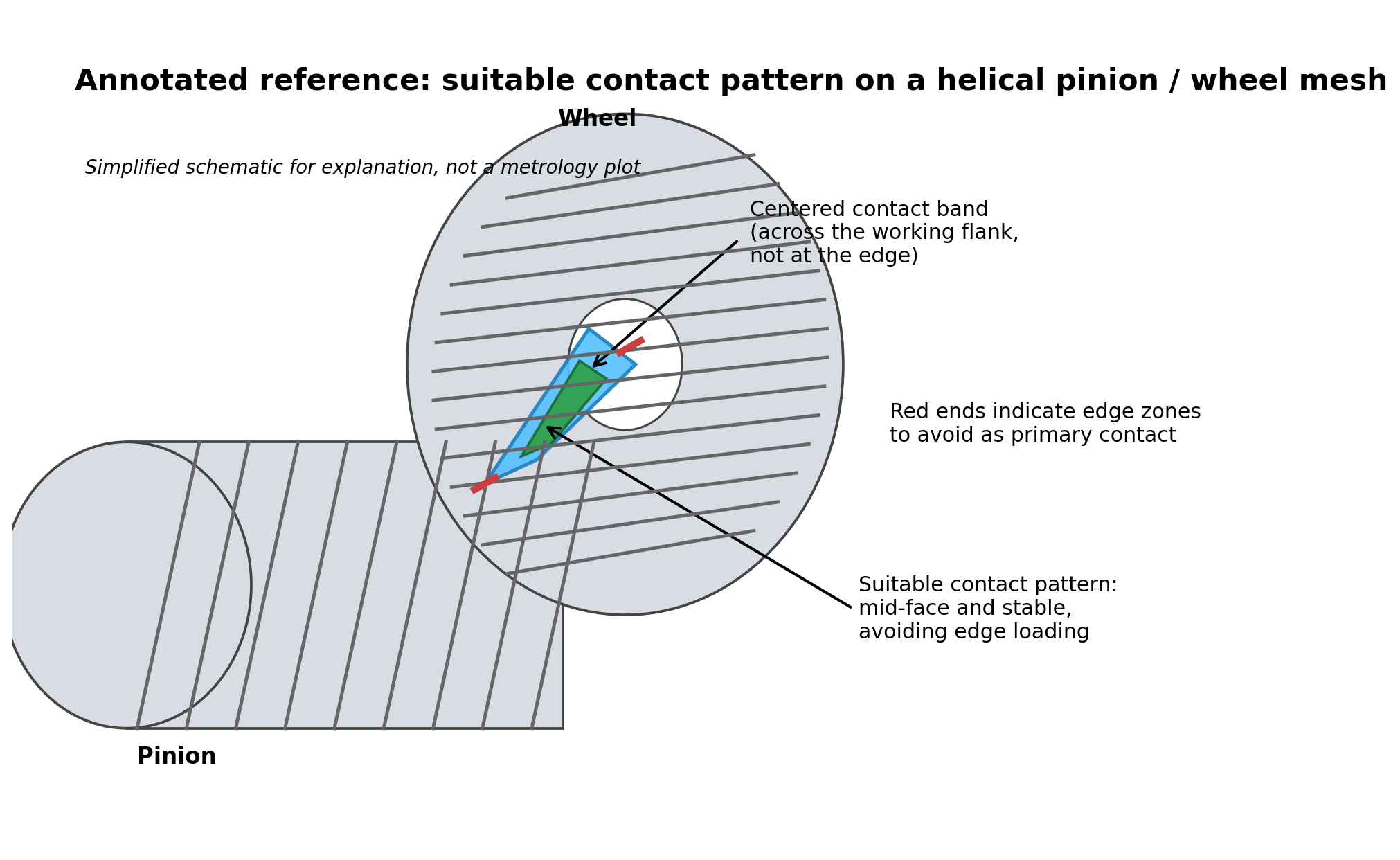
Alternative Hypothesis 1: Why a Replacement Gear Can Fit, but Still Fail Due to Contact Pattern Differences
This is one of the most overlooked causes.
A replacement gear pair may match the nominal drawing dimensions, yet still differ in crucial details such as:
-
lead correction
-
profile modification
-
crowning
-
helix accuracy
-
surface finish
-
backlash behavior under load
These details determine how the load is actually distributed across the tooth face.
If the new pinion and gear do not reproduce the intended micro-geometry of the original design, the load may become concentrated at one edge or in a narrow band. Once that happens, local contact stress rises sharply, the oil film can collapse, and the tooth surface begins to distress very quickly.
In many industrial gearboxes, especially where only the gear set is replaced while the existing housing, shafts, bearings, and mounting conditions remain unchanged, this system mismatch is a very realistic explanation.
Alternative Hypothesis 2: Lubrication Film Breakdown
The visible damage pattern also resembles severe mixed-lubrication or boundary-lubrication distress.
Even a well-made gear can fail very quickly if the lubricant cannot maintain a protective film. Common triggers include:
-
incorrect oil viscosity
-
contaminated oil
-
water ingress
-
poor oil supply to the mesh
-
excessive temperature
-
debris from previous wear or assembly work
Once the oil film collapses, the gear teeth move from controlled rolling-sliding contact into metal-to-metal interaction. The result can be smearing, tearing, scuffing, and rapid surface destruction — exactly the kind of damage many people wrongly describe as “the material was bad.”
Alternative Hypothesis 3: Alignment, Bearing Condition, or Housing Distortion
A new gear set is never working alone. It is part of an assembled system.
If there is:
-
shaft misalignment
-
bearing wear
-
inaccurate assembly
-
improper preload or clearance
-
housing distortion under load
then the contact pattern seen in operation may be very different from the theoretical pattern on the drawing.
This can create edge contact, uneven loading, and vibration. Under those conditions, a replacement gear may fail rapidly even if the material and hardness are acceptable.
Alternative Hypothesis 4: Operating Load Was Not What the Gear Maker Assumed
Another possibility is load mismatch.
Questions worth asking include:
-
Was the gearbox running at normal load during those two days?
-
Were there shock loads during startup?
-
Was there any process upset or jam event?
-
Was the service factor used by the replacement vendor realistic?
-
Did the replacement design consider the real duty cycle rather than only nominal torque?
A gear set that is adequate on paper may still fail if the actual operating condition is more severe than assumed.
 What a Proper Root Cause Analysis Should Include
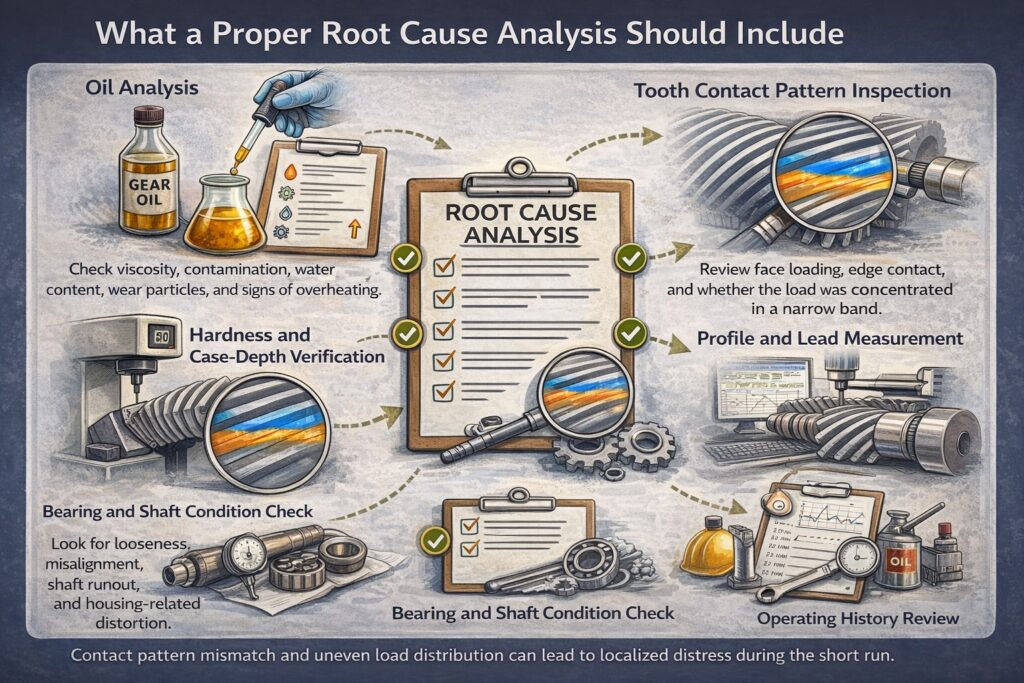
Before concluding that the failure was caused by poor material alone, a structured investigation should include:
-
Oil analysis
Check viscosity, contamination, water content, wear particles, and signs of overheating.
-
Tooth contact pattern inspection
Review face loading, edge contact, and whether the load was concentrated in a narrow band.
-
Hardness and case-depth verification
Confirm surface hardness, core hardness, and effective case depth of both pinion and gear.
-
Profile and lead measurement
Compare the replacement set against the intended gear geometry, not just nominal dimensions.
-
Bearing and shaft condition check
Look for looseness, misalignment, shaft runout, and housing-related distortion.
-
Operating history review
Check load, temperature, startup events, vibration trend, and lubrication practice during the short run.
A More Balanced Engineering View
From an engineering perspective, the most reasonable conclusion is often this:
A rapid replacement-gear failure should be treated first as a system-level failure investigation, not simply as proof of inferior material.
That does not mean the replacement gear manufacturer is automatically free of responsibility. It means the evidence should be tested properly.
In practice, the final root cause may involve more than one factor, for example:
-
marginal micro-geometry reproduction
-
imperfect alignment
-
unstable lubrication during startup
That combination can destroy a gear set very quickly.
Practical Takeaway for Plant Owners and Maintenance Teams
When replacing gears in an existing industrial gearbox, especially through reverse engineering or third-party manufacture, do not focus only on:
-
module
-
number of teeth
-
ratio
-
shaft dimensions
-
basic hardness
Those are necessary, but not sufficient.
The real success factors include:
-
accurate load distribution
-
correct flank modifications
-
compatibility with the existing housing and shaft system
-
validated lubrication conditions
-
proper installation and commissioning checks
A gear is not just a piece of metal. But it is also not only a metallurgy question.
Final Thoughts
Cases like this remind us that gearbox reliability depends on the interaction between design, manufacturing, assembly, lubrication, and operating conditions.
When a replacement pinion fails within two days, “material defect” is one possible explanation — but not the only one, and often not the best first assumption.
A disciplined root cause analysis should come before a confident conclusion.
Need Help Reviewing a Gearbox Failure Case?
If your team is facing unusual gearbox wear, rapid tooth damage, or uncertainty after a replacement gear installation, a structured failure review can help prevent repeated losses.
We support industrial users with practical gearbox troubleshooting, spare-part assessment, and repair-path evaluation based on real operating conditions.
Need help reviewing a gearbox failure case? Contact us for a practical technical assessment.


